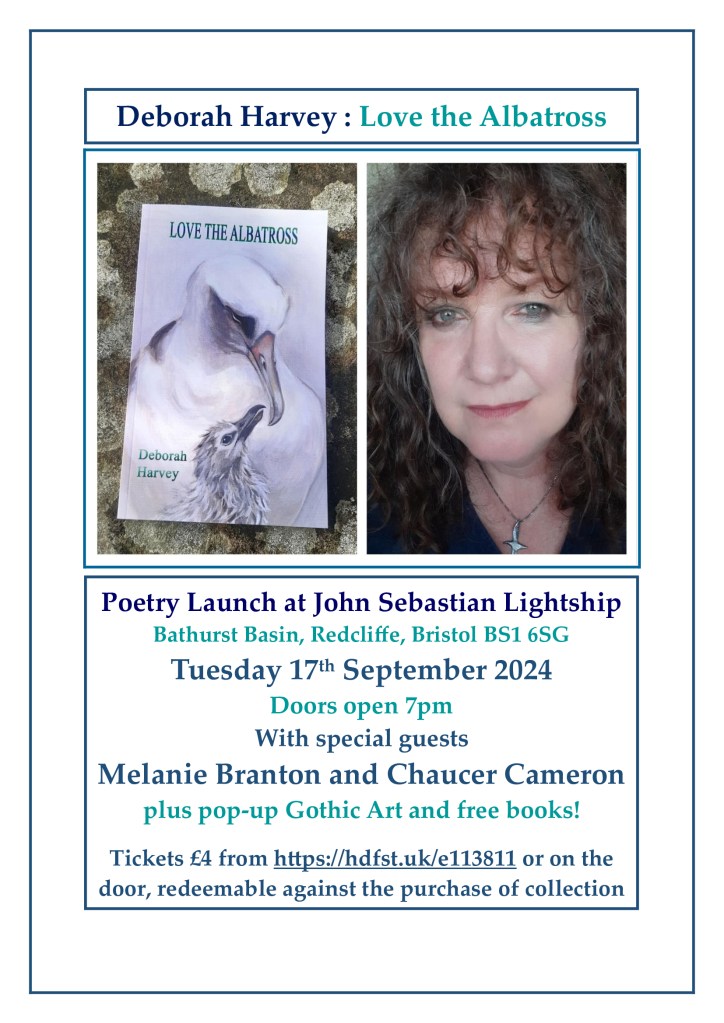
Launching an Albatross

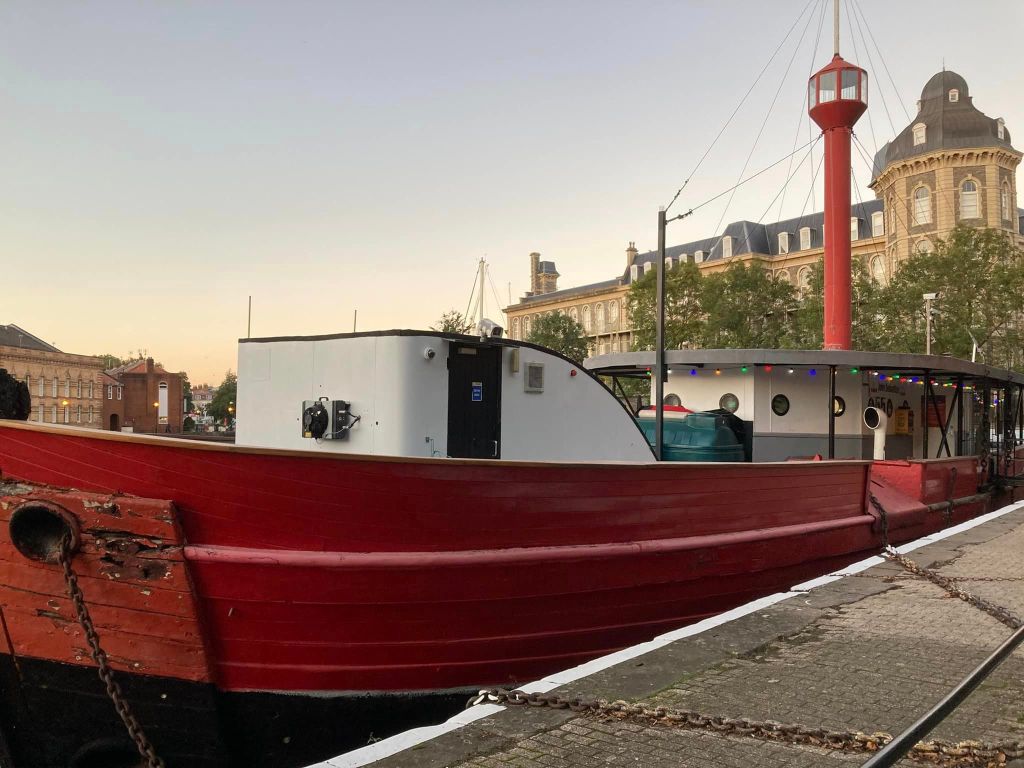
First thing on Tuesday morning I looked into the bathroom mirror and saw something had altered in the eyes looking back at me. And I could feel the woman-who-reads-the-poems – the one I stand just behind at readings, marvelling as she rises to the occasion – making her move early, to hold my hand through the day at work and the difficult rush hour drive down town to the John Sebastian Lightship moored at Bathurst Basin, and step forward at the appropriate moment to launch a handful of albatrosses into the Bristol night. So lucky to have her at my side!
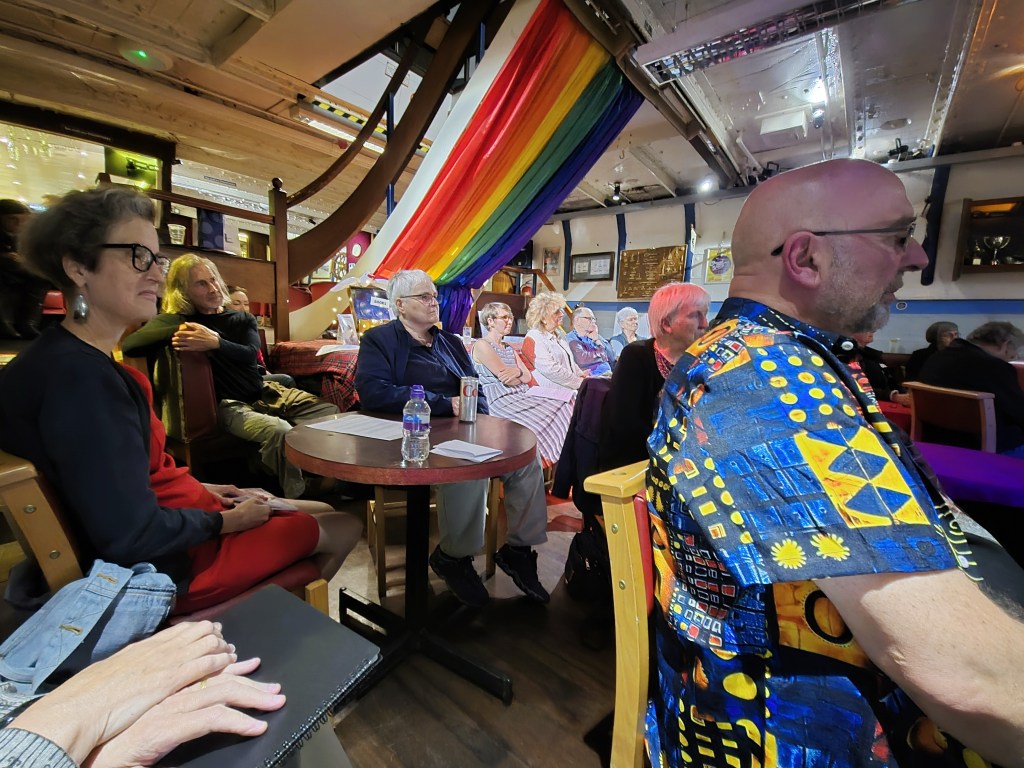
MC for the night was local poetry supremo, Helen Sheppard, another pair of very safe hands. And first, guest readings from Melanie Branton and Chaucer Cameron, two of the most gifted poets and generous women I know, who both understood the cost of writing these poems and launching them into the world. I was so privileged to have them agree to read alongside me. 

My selection of poems was followed on a Q&A on the subject of writing from trauma, hosted by 
counseller and former director of Poetry Can, Colin Brown.
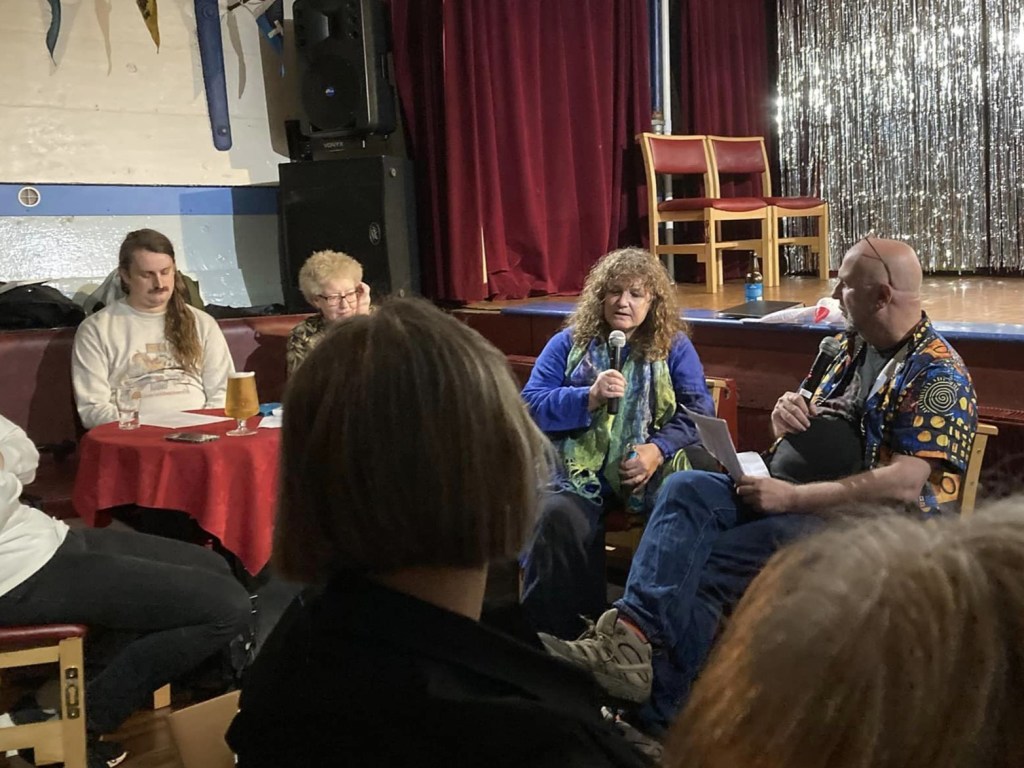
 For anyone who’s interested, here’s a transcript of the question and answer session:

Question:  You mentioned what a very difficult subject estrangement is to talk about, and yet you’ve written a book of poems on that very subject, which you now have to share with the world. What made you decide to do it?

Answer:   I don’t think you can always control which poems turn up and when, and there came a point, about four years ago, when these were definitely the sort of poems that wanted to be written.

Question: Do you know why that was?

Answer:   Well, the latest estrangement from my child was showing every sign of lasting a lot longer than the previous one, so writing poems was a way of engaging with the situation without having to talk about it and risk shame or the judgment of other people, because of course at first it was in private.

Question: Perhaps it was also a way of maintaining a connection with your child? 

Answer:  Oh, the connection was there all right. Writing the poems was a way of managing it, without impinging on their desire for no contact.

 Question:  What do you mean by managing that connection?

Answer:  Well, as I said during the reading, sometimes the relationship you have with someone who isn’t physically in your life is even more intense than if they were present.

Question:  And that must take a toll emotionally?

Answer: Yes. Before I started writing the poems, it felt like I was experiencing all the stages of grief, all at the same time, every day.

Putting all that emotion into poem-sized chunks and working at them meant I could explore it in a measured way, using metaphor and story to try to make sense of it.

Question:  Yes, because you’re not ranting or seeking validation for your own individual situation here, are you?

Answer: Oh, I definitely wanted to avoid that, because that would have stopped the poems making connections with other people. They had to be art, which meant they had to leave room for the reader to inhabit with their own experiences.

Question: And there were your child’s feelings to consider too?

Answer: Absolutely. Above all, they had to respect and preserve my child’s privacy. That’s always been really important to me.

Question:  So, what steps did you take to ensure you did that?

Answer:   Well, not long before the poems started to materialise, my mother broke her hip and went to stay with my sister, who lives in the Midlands, while it mended. And then the pandemic started and she had to stay there, and I suddenly found myself with considerably more free time. So I quickly signed up for an MA in Creative Writing, and used that as a framework for writing ethically about trauma. 

Question:  How did you do that?

Answer:  In the first instance, I studied and wrote essays on poets who engage with personal material and are emotionally authentic without compromising their integrity or privacy … Elizabeth Bishop and Denise Riley spring to mind.

Question: Did the course also affect your own practice? 

Answer: Yes, I became very strict with the content of my own poems, making sure that they revealed emotional truths but not ‘my truth’, because you can be sure my version of events isn’t how my child sees things.

Question: And this is where the ethics come in?

 Yes. I didn’t think it would be fair to use my platform, such as it is, to deny their truth, even if it doesn’t fit with mine.

Question:  ‘The stories we tell ourselves to justify our actions’ is an idea that appears at various key points in this collection – in fact, there’s a thread of poems about it. Why is this important to you?

Answer:   I don’t know if everyone does this, but I definitely think writers – and artists in general – tell themselves stories in order to make sense of difficult situations.

Question: And some of the poems hint at stories taking over and getting out of control … 

 Answer: Yes, and that’s to be avoided at all costs. Your relationship with your story has to remain a truthful one, and that applies whether you’re making art about the situation you find yourself in or just living it. 

Question:  Finally, you facilitate poetry writing groups in Bristol. If someone asked you what your ONE best tip for writing about a deeply personal issue, what would you tell them?

Answer: I’d say … exploit the unique nature of poetry. It’s a collaborative art, so always leave space for the reader to bring their own experience.

One way of doing this is to write ‘ghost’ poems – ones which convey your story without actually telling it, so that instead of splurging every last detail, you simply communicate the emotional truth of the matter.

And if I can add a second tip! – read poets who do this well, like Selima Hill, Sharon Olds, Ruth Stone, Caroline Bird, Kim Moore … there are so many of them. 

The ensuing questions from the audience were thoughtful and insightful and the evening ended on a very warm and positive note. 

Then it was time to heave a bit of a sigh of relief and head for home, where a chilled bottle of champagne and a warm dog were waiting. 

With many thanks to Indigo Dreams Publishing, Colin Brown, Helen Sheppard and the Satellite of Love Poetry and Open Mic team, Katie Marland, Melanie Branton and Chaucer Cameron. 
Our Deb graduates from Manchester Writing School with an MA in Creative Writing

Congratulations to our Deb, who last week got the chance to dress up and totter across the brightly-lit stage of Bridgewater Hall in Manchester without falling over, thus graduating from the Manchester Writing School with a Distinction in her MA in Creative Writing.

We’re delighted that the collection of poems on the theme of estrangement that Deb wrote during her MA will be published by Indigo Dreams Publishing in 2024. Details to follow.

Anticipating ‘Fontanelle’ by Helen Sheppard

We’re delighted that another Leaping Word poet, Helen Sheppard, is about to deliver ‘Fontanelle’, her debut collection of poems.

Helen is well-known in the Bristol poetry community and always keen to champion the work of others, which is why the prospect of reading a book of her poems is such a pleasure.

And what a book. You often hear people call poetry collections ‘important’ when they aren’t particularly, whatever other value they might have. However, ‘Fontanelle’, which compares and contrasts Helen’s experiences as a midwife working in the NHS during the 1980s and 90s, with that of her Aunt Doreen, who delivered babies in an earlier, more perilous yet less impersonal era, fully deserves this epithet.

‘Fontanelle’, which is published by Burning Eye Books, will be welcomed into the world this 23rd September, and its launch is taking place at Waterstones in Bristol the following day, Friday 24th September at 7pm.

critiquing poetry in a time of covid

It’s been nearly a year since we held our last monthly poetry group meeting in the light and airy music room in Bristol’s Folk House, before the first lockdown was implemented. I don’t believe even the most pessimistic of us there that day imagined that we would still be living and writing in varying degrees of isolation all this time later.

We’ve kept our poetry groups going by email and Facebook group, with the occasional Zoom meeting for good measure. When we first came up with the idea of weekly prompts and feedback for the duration of our exile, again I don’t think we anticipated the situation lasting to the point where we have now received and critiqued several hundred poems. But it has kept us and our poets busy and out of mischief.

In the summer I had a rush of blood to the head and have now embarked on an MA in Creative Writing at Manchester Writing School, and one of the modules requires us to … yes, critique each other’s poems. And because you can never have too much practice, here’s one written just for fun.

Hi Bob

Thank you for sending us your poem, ‘Stopping by Woods on a Snowy Evening’. We think this is a promising early draft.

You set the scene well. The narrator is making a journey, accompanied by a horse pulling a sleigh. It is evening and there is snow. Nearby there are woods, and at a distance a village. The narrator pauses and then considers continuing his journey.

You capture this opening scene with such precision that it is a surprise to the reader when the poem fails to progress beyond it. We wonder if you have been struck by writer’s block or had a particularly busy week? Have you considered having something happen in the poem? Maybe there could be an attack by a highwayman, or a chance encounter with a young man and his heavily pregnant girlfriend, who are from out of town and need a lift to a nearby inn? Who knows where the story could go from there.

We have a few specifics to draw to your attention.

First, the title. We don’t think it’s working hard enough for you. You could use it to locate your poem more precisely, as in ’Stopping by Michael Wood just outside Thornbury on the M5 northbound on a Snowy Evening’, or add an air of mystery by calling it ‘The Numinous Snow’.

In the opening line, the inversion feels very archaic to us. It would sound far more natural if it read ‘I think I know whose woods these are’. Of course, you would then have to alter the entire rhyme scheme of the poem, but it needs attention anyway, as ‘though’ at the end of the second line is clearly there just to rhyme with ‘know’. In fact, end rhymes are rather old-fashioned, as is the tum-ti-tum metre of the poem. You could really add interest by breaking the poem up with some enjambment and the addition of internal and half-rhymes.

In line 1, stanza 2, ‘queer’ is a somewhat problematic choice of word. At best, you risk wrong-footing your reader; at worst, it’s cultural appropriation. And of course, making assumptions about what the horse is or isn’t thinking is an example of anthropomorphism and best avoided.

Lines 3 and 4 of this stanza are superfluous. You have already mentioned the woods, and the frozen lake is irrelevant to the action of the poem as it stands currently.

It is frustrating that although you return to the horse in stanza 3, its potential is not fully explored. The harness bells add a picturesque, almost whimsical touch, but we know nothing of the animal itself. What colour is it? Does it have a name? There is so much more interest that could be added at this point.

In the final stanza, the repetition of the last two lines makes for a slightly weak finish. We suggest you substitute line 4 with something like ‘in a Berni Inn that’s clean and cheap’.

Finally, Bob, we hope you don’t mind if we point out that you’ve been writing rather a lot of these little New Englander poems lately. They can only ever be of local interest. Have you thought of writing something more culturally appealing, such as a riff on Love Island? Or a poem on a theme everyone can relate to, like picking up a prescription on a Saturday with the kids in tow when they’d rather be flying their kite? You could call it ‘Shopping in Boots on a Blowy Morning’.

All the best with it, Bob. We think you have the makings of an interesting poem here, and look forward to seeing a much later draft.

Warm regards

Colin and Deb

Anticipating ‘Earthworks’ by Stewart Carswell

We’re absolutely delighted that a collection by Stewart Carswell, who used to workshop his poems with The Leaping Word while studying for his PhD in Bristol, is to be published by Indigo Dreams Publishing in 2021.

Entitled ‘Earthworks’, the collection explores the connection between human relationships and British landscapes, and how these are influenced by a greater backdrop of history and politics. In particular, the poems draw upon locations and  heritage from across the West Country, including West Kennet long barrow in Wiltshire, Offa’s Dyke in Gloucestershire, and the industrial heritage of the poet’s native Forest of Dean. 

Stewart adds: “‘Earthworks’ features poems I have been working on over the last five years, since my first pamphlet ‘Knots and Branches’ (Eyewear publishing) appeared, such as ‘Silver Turn’, which is influenced by the Roman temple in Littledean, Gloucestershire, overlooking a large meander in the River Severn.”

‘Silver turn’ is available to read on Stewart’s website.