Tracy K Smith at the Bristol Festival of Ideas

In these days of sweeping funding cuts, the chance to see top poets reading locally come along only a couple of times a year, yet I can think of no more valuable a way for poets to learn and be inspired than to listen to the best of their peers reading their work in person. So when I learnt that Tracy K Smith, the US poet laureate, was coming to Waterstones in Bristol as part of the Festival of Ideas, I seized the opportunity of seeing her.
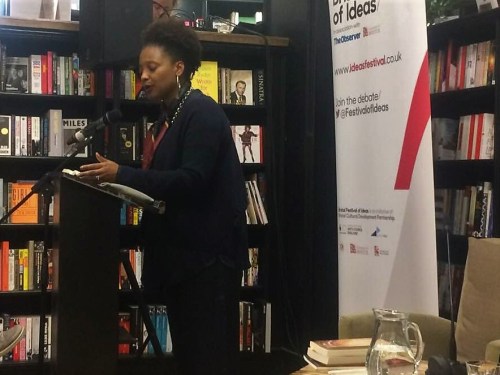
Tracy K Smith

Most poets tend to write about a corner of their own experience or a particular interest – for example, you might think of yourself as  an eco-poet, or someone who is especially good at capturing what it means to be a survivor, or a poet suited to political declamation. Smith herself is known for poems about the body, focusing on intimacy, love, and sexuality, but her work also encompasses, apparently effortlessly, political poems of enormous sensibility and empathy, such as the sequence she read from her second collection, ‘Duende’, which gives voice to Ugandan women kidnapped by rebel commanders, and such vast subjects as … well, the universe.

‘I don’t have a great brain for science,’ she claimed, to a frankly disbelieving audience during her reading of her sequence ‘My God, it’s full of stars’ from her 2011 Pulitzer-prize winning collection, ‘Life on Mars’. But in case you’re starting to think her work might be altogether too rarified, the quote about stars is from Arthur C Clarke’s novel, ‘2001: A Space Odyssey’, proving that Tracy isn’t afraid to tangle with pop culture either. She even writes affectingly about that ultimate starman, David Bowie.

And as you wing out across the universe of Tracy’s poems, you are being lifted on the most perfectly pitched reading of them. I would urge any poet who wants to improve their delivery of their work to listen to her read. There are lots of videos on line, or you can buy a CD of Duende. Better still, go and hear her read in the flesh … though now her book tour has ended, you might have to fly to America for that.
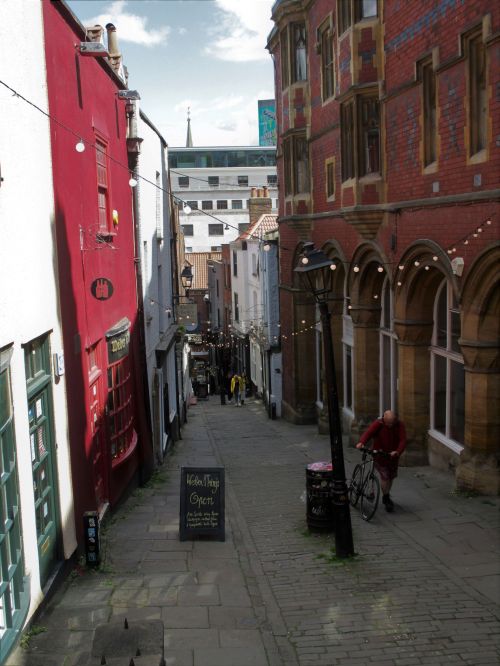
 

The new venue for Silver Street Poetry

With just ten days to go before the first meeting of Silver Street Poetry in its new home, it feels timely to share our photos of our visit there today and remind our poets of its location.

IMG_0010

We parked in the Galleries – although Trenchard Street car park is nearer, of course – and took the scenic route to get there, via Christmas Steps. (Other, less precipitous approaches – for instance, walking up Colston Street from the Centre – are available.)

IMG_0015

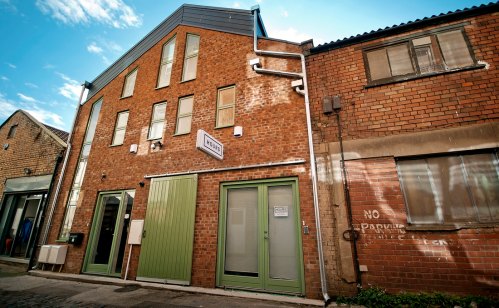
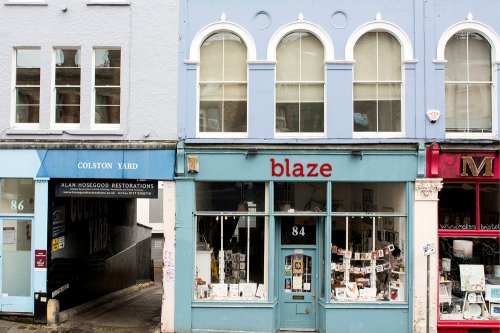
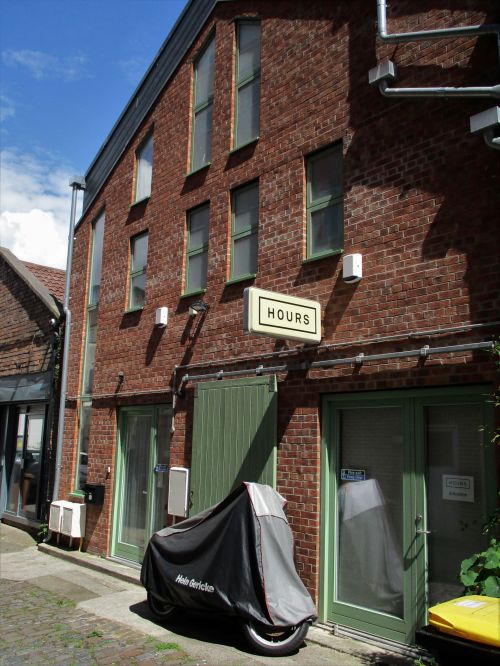
Hours is at 10 Colston Yard, which is reached from Colston Street. What fascinates me about it is that although the entrance is at ground level and therefore fully accessible, it is built into the side of the hill, and the views are amazing. I’d only been there in the dark before, so I was quite excited to get a new perspective on a familiar area.

We checked and it’s fine for poets to bring their own refreshments from nearby cafes, of which there are many.

We returned to Broadmead via Johnny Ball Lane, which passes below Hours and the other buildings of Colson Yard. Here they are, perched atop this magnificent Victorian wall.

IMG_0025

Just time for a quick coffee in Revive Cafe at the top of Corn Street.

IMG_0037

See you on Friday 7th June at our original time of midday and at our new venue of Hours, for hours – well, an hour and a half – of poems shared with friends.


Silver Street is on the move

SILVER STREET POETRY

Big changes down Silver Street this month, with the news that we are on the move!

Unfortunately the dance studio we’ve been using at the Station is no longer available, so from next month, Friday 7th June, we’ll be holding our popular open mic in the attractive, modern space that is Hours, situated in Colston Yard, off Colston Street. The room we are using is on the ground floor and fully accessible, as is the WC.

The full address is 10 Colston Yard, Bristol, BS1 5BD, and the nearest affordable car parks are at Trenchard Street (0.2 miles) and the Galleries in Broadmead (0.5 miles). It is 0.4 miles from the bus station.

Please note also that we are reverting to our original, earlier time of 12 to 1.30pm.

Hours

If you aren’t sure of the exact location of Colston’s Yard is, fear not: here is a map.

Hours space map

The entrance to the Yard is pictured below.

Colston Yard

June’s guest poet at Hours will be Ross Cogan, the Creative Director of Cheltenham Poetry Festival, whose third collection, Bragr, is published by Seren. Don’t forget to bring a poem of your own or someone else’s to share. Entry fee is £3.


Alice Oswald reading at the Bristol Poetry Institute

Alice Oswald

We’re big fans of Alice Oswald’s poetry, so when we saw that she was delivering this year’s annual reading from the Bristol Poetry Institute, we leapt to get tickets.

Though it’s not just her poems we love; it’s the way she performs them too. The previous time we heard her read, at Bristol Watershed in May 2013, it was from ‘Memorial’ and ‘A Sleepwalk on the Severn’, Alice grabbed the audience by the collective scruff of its neck and addressed it with her work, which she read from memory. It was intense, dramatic and mesmerising; the best reading either of us had ever been to.

This time she read her long poem, Nobody, which is ostensibly about a bit-part player in the Odyssey: the poet who was charged with guarding Clytemnestra by Agamemnon, and subsequently marooned on a rocky island in the middle of the Mediterranean by the queen’s lover, Aegisthus. Really, though, it’s a paean to the ocean, and as Alice recited it by heart in the darkness of the Great Hall at Bristol University, we found ourselves rocked in its rhythms. Nothing disturbed the swell of the narrative, and when, after an hour, it ended and we could finally fidget, I found I could barely shift for the pain of having sat so still for so long, without really having noticed.

nobody

The reading was followed by a very interesting question and answer session. Particularly fascinating was answer to the chicken-and-egg question of how much the poem is shaped by the effort of memorising it. Alice said her memory is her editor; if she can’t memorise a section, she is liable to expunge it as not working.

Arthritis notwithstanding, it was a fabulous reading in the truest sense. If you get a chance to go and hear Oswald, seize it. It’s an experience you’re unlikely to forget.